

At Patch My PC, we prefer not to talk about our competitors a whole lot. Not because we fear comparisons but because we have values that we earnestly try to live by. It is no coincidence that our first value is We are Humble and the second is We Avoid Shenanigans. We would rather focus on the excellent work our product team does than try and give you our biased opinions of a competitor’s offering. Admittedly, it doesn’t hurt to have customer after customer happy to do so: Patch My PC Customer Testimonials.
That said, we recently concluded a very unpleasant interaction with Ivanti that we felt we should address, given that it is of public record and likely to be a prominent search result. In short, Ivanti sued us for alleged patent infringement, and we won. If you want more detail, read on, but the takeaway is that a lot of money and focus that could have been put into improving our product was spent on a frivolous lawsuit instead.
So What Happened?
On October 21, 2021, a business development representative from Ivanti reached out via multiple channels over several days to arrange a meeting with our founder, Justin Chalfant. Based on the communication, it appeared Ivanti wanted to chat about some type of partnership. We use Calendly to take meetings with external companies and our customers easily.
However, this particular meeting was unusual in that within minutes, Ivanti’s representative claimed that we violated their intellectual property and told us to expect an overnight FedEx delivery of a patent assertion letter the next day. On the call, they proposed the following options: sell Patch My PC to Ivanti, pay Ivanti a per-device licensing fee, or prepare for legal action.
Note: We are not lawyers. What follows is the admittedly our biased opinion.
What Did Ivanti Claim?
When we received the assertion letter the next day, it made claims regarding three patents: 6,990,660, 7,823,147, and 8,407,687. What these patents outline, in general, is how a central server delivers update metadata and binaries to an agent and uses the information to decide if the update applies to that device. If that sounds like Windows Server Update Services (WSUS) or Configuration Manager (SCCM/ConfigMgr), then you wouldn’t be far off, and in fact, their patent assertion letter (available here) was full of screenshots from Microsoft’s documentation for WSUS and ConfigMgr. In essence, we were being sued because WSUS and ConfigMgr exist, and our products use their publicly documented APIs. It’s worth noting that in our research, we could not find a public record of Ivanti litigating these patents against the company their assertion stated violated their patents: Microsoft. Instead, they have a record of litigating against smaller companies like Patch My PC and Shavlik Technologies, which integrate with Microsoft’s products.
After several back-and-forth exchanges where we stated and sent comprehensive documentation that none of our products did the things claimed in their patents, Ivanti ceased communicating. Hoping they had seen the light, we breathed a collective sigh of relief and began going about the rest of our lives. Hope, however, is a double-edged sword, and two months later, Ivanti filed a lawsuit in the federal courts of Colorado: DCO-1-22-cv-00643-1.
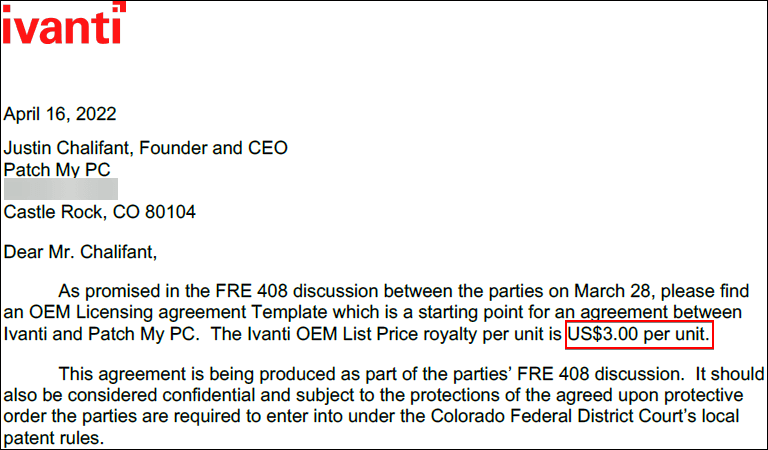
A few weeks after filing, Ivanti offered to settle the case if we licensed their patents for $3 per unit. Given that our most expensive product SKU at the time was $3.50, we declined their offer.
Dismissal Under U.S. Code § 101
The three patents in question are very old; by the end of the case, two had reached their twenty-year expiration. When Ivanti first approached us, two of the three patents had less than 1-year left. Several significant changes to the software patent landscape occurred during those two decades. The 2014 patent case Alice Corp. v. CLS Bank International is the most relevant. In Alice, the United States Supreme Court stated: “computer system merely ‘configured’ to implement an abstract method is no more patentable than an abstract method that is simply ‘electronically’ implemented.”
Essentially, you can’t just take a pre-existing process, add ‘but on a computer,’ and patent that. Ivanti’s patents cover the decision process of whether a computer needs a particular update. System administrators have performed this task since the dawn of software. Our legal team communicated to Ivanti that their patents were almost certainly invalid under Alice and that we would be filing a motion to dismiss based on U.S. Code § 101. We even shared our motion to dismiss Under 35 U.S.C. §. 101 with Ivanti on May 2, 2022, and we told them if they didn’t drop the case, we would file the motion with the court. Ivanti respectfully disagreed with our position, so we filed the motion.
Exactly 1-year later, untold riches, and many legal meetings later, the judge in the case (honorable Judge Nina Y. Wang) granted our motion to dismiss: 2023 04 13 DI 047 Order On Motion to Dismiss. The money shot:
This Court is persuaded that the first independent claim of each of the Patents-in-Suit is analogous to those cited by Defendant, and simply utilizes known components—like the patch fingerprint—in understood and conventional ways. Indeed, nothing in the claim language employs specific directions regarding programming or even instructions for what information the patch signature and/or the existence test is using or how it should be used, or how monitoring is accomplished. Instead, the Asserted Claims utilize generic statements regarding information gathering and exchange; use of such information within configurations; and monitoring the attempted download for an outcome. Plaintiff’s conclusory arguments that the claims embody multiple inventive concepts are not supported by its citations to the claim language or the specification
Thus, based on the record before it, this Court concludes that the Asserted Claims are invalid as claiming unpatentable subject matter under 35 U.S.C. § 101. The Court will thus GRANT the Motion to Dismiss..
In response, Ivanti filed a motion stating (again, we’re not lawyers here): “The judge must be wrong because that sounds like we lost the case.” As luck would have it, the judge was not swayed by this argument and denied their motion.
Realizing they would lose, Ivanti offered to voluntarily dismiss the case and any possible appeal in exchange for us dropping our claim for lawyer fees. Happy to be finally done with this debacle, we agreed, and the case was officially dismissed.
What Did This Mean For Patch My PC
It meant a lot of time and money was wasted on a needless lawsuit. More importantly, it meant that our leadership had to focus on protecting our business instead of improving the company and, by extension, our customers. We are a small company, and we strive hard to maintain a laser-like focus on our customers. That’s hard to do when a company, many times your size, decides to try to sue you.
We held firm that we were in the right, persevered, and ultimately, the courts agreed. As a result:
- Ivanti received no licensing fees from Patch My PC
- Ivanti’s three patents asserted against Patch My PC were deemed invalid by the courts
- Ivanti won’t be able to assert these patents against other smaller companies in the patch management space
We would have much preferred that this whole debacle never happened, but this was the perfect outcome, given that it did. It is gratifying to know that justice prevailed in the end.