
Back in the heady days of March 2023, the Microsoft Intune team made a big announcement: they were going to bring a suite of advanced endpoint management capabilities called the Microsoft Intune Suite as an add-on to Microsoft Intune. The goal was to fill common gaps found in the cloud-based endpoint management market.
Fast forward a couple of years, and last week Microsoft announced that each product included in the Microsoft Intune Suite will be included in the Microsoft 365 (M365) E3 and E5 subscriptions: Advancing Microsoft 365: New capabilities and pricing update
What did they actually do, why did they do it, and what open questions remain? That’s what we’ll dig into in this post.
What Just Happened with the Intune Suite?
The big news is that the Microsoft 365 E3 and E5 subscriptions now include all components of the Intune Suite. Microsoft has added Intune Remote Help, Microsoft Intune Advanced Analytics, and Microsoft Intune Plan 2 (Tunnel for MAM and Specialty Device Management) to the Enterprise Mobility and Security (EMS) E3 license. Since EMS E3 is included in the Microsoft 365 E3 subscription, those features are included in that subscription as well.
By contrast, Intune Endpoint Privilege Management (EPM), Intune Enterprise Application Management (EAM), and Microsoft Cloud PKI are included with a Microsoft 365 subscription. That is: they were not added to the underlying EMS E5 subscription and are only available if you purchase the full Microsoft 365 E5 subscription.
Here is a helpful chart from the announcement:
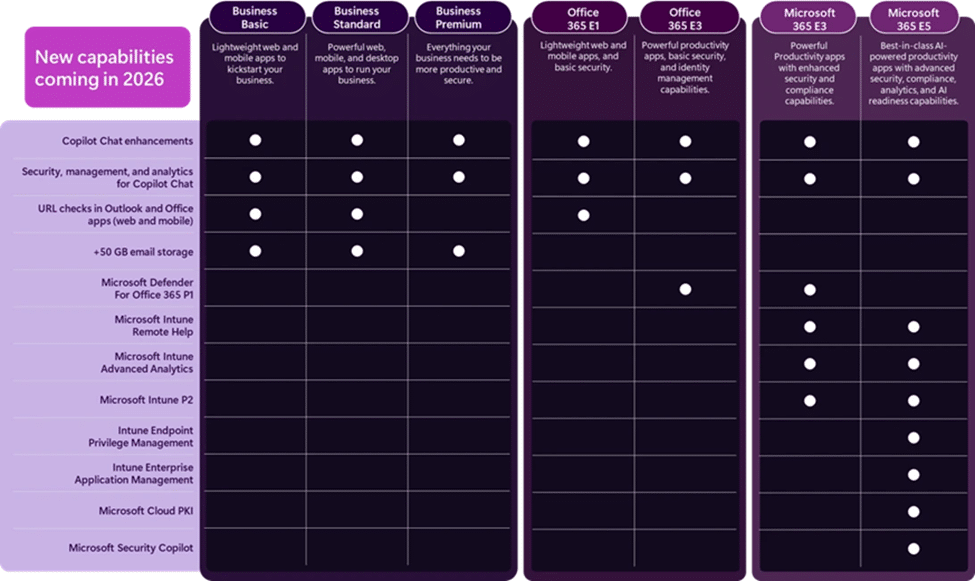
These additions to the Microsoft 365 E3 and E5 subscriptions quickly followed Ignite’s announcement that E5 will include Microsoft Security Copilot. The details matter here: this is not a carte blanche free ticket to Security Copilot. For every 1000 E5 licenses purchased, customers will receive 400 Security Compute Units (SCUs) per month. SCUs are the unit used in the consumption billing model of Security Copilot. That 400 number will be prorated to the exact number of licenses purchased, even if it’s lower than 1000.
Great, Free Stuff in Microsoft 365
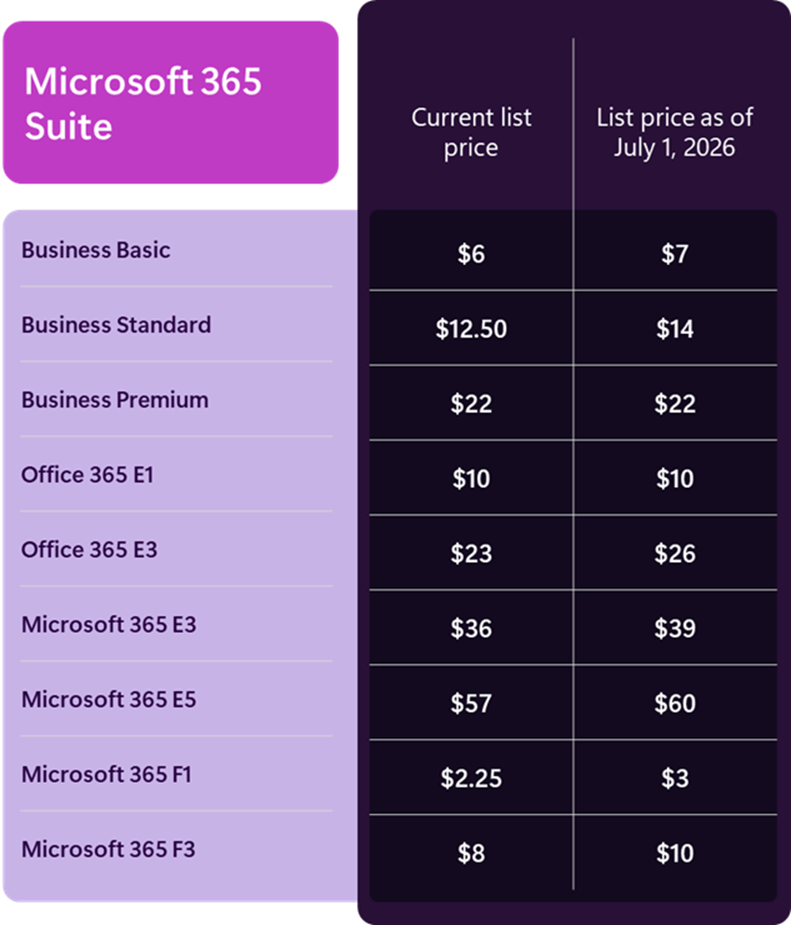
Ah, yes, about that. Alongside this announcement regarding the Microsoft Intune Suite, Microsoft has also announced price increases for several subscription SKUs, as outlined in the chart below. Crucially, the Microsoft 365 E3 and E5 subscriptions will both increase by $3/user/month.
And Because Microsoft Loves Surprises
This summer, Microsoft announced that companies with Enterprise Agreements would lose the built-in volume discounts as of November 1st, 2025: Microsoft Online Services: Pricing Consistency Update.
If you’re unfamiliar: under an Enterprise Agreement (EA), specific discounts were automatically applied based on the number of licenses you agree to purchase. From that point, you might still negotiate lower pricing based on other variables, but it sets the starting point. The discount brackets looked something like this:
| Level | License Count | Discount |
| A | < 2400 | 3% |
| B | 2400 – 5,999 | 6% |
| C | 6,000 – 14,999 | 9% |
| D | > 15,000 | 12% |
Those discounts are now gone, and the price everyone is negotiating from is the same: list price. Certainly, larger customers who are well beyond the 15k top tier were getting, and will still be able to negotiate, significant discounts. However, smaller companies should expect to lose those discounts and experience significant price increases at their next renewal.
The bottom line: expect a very significant price increase at your next renewal unless you are a very large company with 10s or 100s of thousands of devices.
Why Microsoft Made the Change and Raised Prices
From the very beginning, the suite was somewhat controversial for not being included in the highest Microsoft 365 E5 subscription. Microsoft told its commercial and government clients that Microsoft 365 E5 offered everything they needed for endpoint management and security. Customers who invested the extra $21/user/month to jump from Microsoft 365 E3 ($36) to E5 ($57) thought they were getting it all. They were displeased to learn that a separate $10 subscription would instead be needed to address key gaps.
The result: few organizations purchased the full suite. Conference after conference, informal polls revealed that very few organizations purchased the entire suite. Those who did reportedly received huge discounts in the 60-70% range. In the end, it was not driving huge new revenue.
Why Now?
The real question on many of our minds isn’t why, but why now? The announcement came a mere two weeks after Microsoft Ignite, for which Microsoft regularly holds back large announcements like this. I’m told there’s a good story, and it requires a minimum of two beers to tell. That said, it’s important to understand how monumental a task this was to pull off even if externally it seems like a no-brainer. To convince the existing stakeholders of the Microsoft 365 revenue streams to take less of the pie to make room for the Microsoft Intune Suite is nothing short of a herculean task. Sure, they dried their tears with the Microsoft price increases we’ve talked about, but it is nothing short of a miracle. Be sure to ask your friendly Customer Success Account Manager (CSAM) to send your regards to the people who made it all possible.
If we accept that most customers were actually paying $3-4 for the Intune Suite, and we can’t know that for sure, then this change might generate more revenue for Microsoft without increasing sales volume. If you are currently purchasing Microsoft 365 E5, then it’s a wash: you are getting the whole suite for the same $3 you would have paid for it before. However, if you are a Microsoft 365 E3 customer, you are now paying $3 but receiving only part of the suite rather than the full suite.
When? Real Soon™!
The announcement was vague about when this would all happen. The only certainty is that, as of July 1, 2026, list prices will increase as described above. Rolling out the parts of the Microsoft Intune Suite to all existing customers means onboarding tens of millions of devices. That will be done as a slow roll, not a big bang. It seems logical that they will roll these out ahead of the price increases, but we won’t have clarity on that until next year. Microsoft stated that it will send notifications 30 days in advance via the Microsoft 365 Admin Center to give its customers ample time to prepare.
The Questions Everyone Is Asking
Immediately upon this announcement, questions flooded in. Here’s what we know so far.
What About Education (A3/A6) or Frontline Workers (F1/F3)
Always the very first question with a predictable answer: no. Not yet. Maybe later. Don’t hold your breath.
Is this available in GCC, GCC-High, or DoD?
The next most popular question: No changes were announced here. This was purely a licensing change; support for different cloud environments is a totally separate thing.
Ok, But Do GOVERNMENT subscriptions (G3/G5) Get the goods?
Yes, the Microsoft 365 G3 and G5 subscriptions include the same features as their E3/E5 counterparts. They also get similar price increases: G3 will see an 8% increase, while G5 will see 5%.
Do Microsoft 365 E3 customers now receive the entire Intune Suite, or only certain capabilities?
They will only receive parts of the suite: Remote Help, Advanced Analytics, MAM Tunnel, and Special Device Management.
Can customers still renew the Microsoft Intune Suite, or is Microsoft phasing it out?
If you are an E3 customer and are one of the few, the proud, who have already purchased the Suite, will you be able to renew it if you do not wish to move to E5? Is the suite truly dead? If it’s not, would it be made cheaper to account for these changes?
The answers are unknown at this time. For the time being, no changes have been announced, so it is presumed that you can still buy it.
Is Anything Being Added to Enterprise Management and Security (EMS) E5?
No, EMS E5 remains unchanged. If you are purchasing EMS and Office E5, then you only pick up the parts added to EMS E3 (Remote Help, Advanced Analytics, Microsoft Intune Plan 2).
But Surely Microsoft 365 Business Premium is Gonna Get The Goods… Right?
Never change my SMB friends. No.
What About the Microsoft 365 E5 Security Add-On?
There’s no clear answer here, but for now I would assume the answer is no, given the way they sliced the parts of the Suite between EMS E3 and Microsoft 365 E5.
Oh, Hello Elephant, Welcome to the Room
The astute administrators among you may have connected the dots: Microsoft is now including Enterprise Application Management, a competitor to Patch My PC’s solutions, as part of Microsoft 365 E5 for Intune-managed devices. First, at $720/user/year, we wouldn’t say they’re exactly giving the thing away. We are still assessing the implications for our current and potential customers and need to revisit our previous review of Enterprise Application Management. However, we remain convinced that the value we deliver at $3.5/user/year is a compelling, cost-effective offer. We are continuously investing in this area; we are not done yet, and we are excited about the features we are preparing to release.
The Final Verdict
In the end, this is a massive win for everyone: Microsoft’s customers and Microsoft itself.
For customers, especially as sysadmins, we no longer have to wage a budget fight to fill the gaps we know exist. If the $10/user/month list price of the suite made it a non-starter for you, that’s gone now. If you looked at Microsoft 365 E5 previously and didn’t see the value, look again, maybe it’s there now.
For Microsoft, price increases have never been huge PR wins. It’s been hard to pass on their increased costs, and their costs have certainly increased, to the customer. By providing something in return, the reaction is far more optimistic. To quote a fellow system administrator: “This might be scummy of M$ to do … but I am actually pretty happy with this change.” If you’ve managed to get system administrators, ones using the M$ nomenclature, on your side for a price increase … you’ve clearly done something right.